Play Next
View all →



About this game
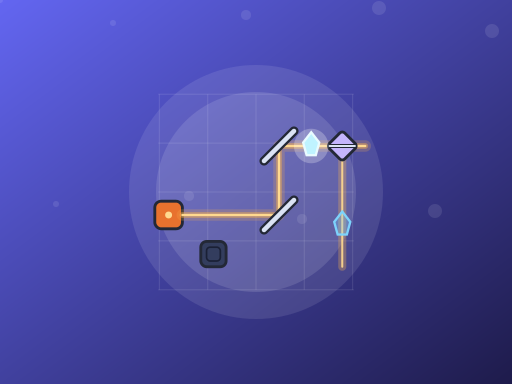
Code Bot is an icon programming puzzle in the Lightbot tradition. A little robot waits on a grid of floor tiles, walls and raised platforms, and your job is to write the program that lights every target tile. The command set is pure symbol: forward, turn left, turn right, jump for steps up and down, light, and the circled calls to procedures P1 and P2. MAIN holds twelve slots, P1 unlocks at level five with eight slots, and P2 joins at level thirteen with six, and procedures may call themselves, so a seven tile loop can drive a forty step route until the depth limit stops a runaway stack. Twenty four levels in four chapters move from straight lines and lighting, through turns and loops, to jumps and high ground, then to master optimization where every star is double scored: three stars demand both the exact minimum step count, proven by an exhaustive solver at build time, and a program no longer than the reference solution. Two stars accept up to one and a half times the optimum, one star simply means you finished. Your best star total is saved on your device.
How to play
Tap command icons into the MAIN slots, or into P1 and P2 once unlocked, then press Run. Light all target tiles to clear the level. Fewer steps and fewer tiles earn more stars.
Tips & Tricks
- Read the par line in the header: the lightning number is the minimum steps and the gem number is the reference tile count for three stars.
- Store any repeated pattern in P1 or P2 and call it with the circled numbers instead of copying tiles by hand.
- A forward step into a wall or a ledge wastes one step but never ends the run, so testing a guess is safe.
- Jump lands on a tile and lights a target there for free, which often saves the separate light command.
Frequently asked questions
How are the three star targets decided?
Every level is solved exhaustively by a breadth first search over position, heading and lit tiles at build time, so the minimum step count is exact. Three stars need that exact step count and a program no longer than the published reference tile count. Two stars allow up to one and a half times the minimum steps.
What happens when a procedure calls itself forever?
The interpreter counts call depth and stops the machine at depth sixty four with a stack overflow animation. Nothing is lost: the program stays editable, so you can fix the loop and run again.